
WELCOME BONUS 300%
UP TO €2000 + 100
FREE SPINS
UP TO €2000 + 100
FREE SPINS
Home → Blackjack
Blackjack at Gamdom Casino: Variants, Rules and Payouts
What Peek Means with a Dealer Ace
The dealer peeks at the upcard when it is an Ace to determine if they hold a natural Blackjack, which immediately affects the player's decision to place Insurance. This specific check occurs before any other actions like splitting or doubling are permitted, ensuring that players do not lose their entire stake on a secondary bet if the dealer already has a winning hand.
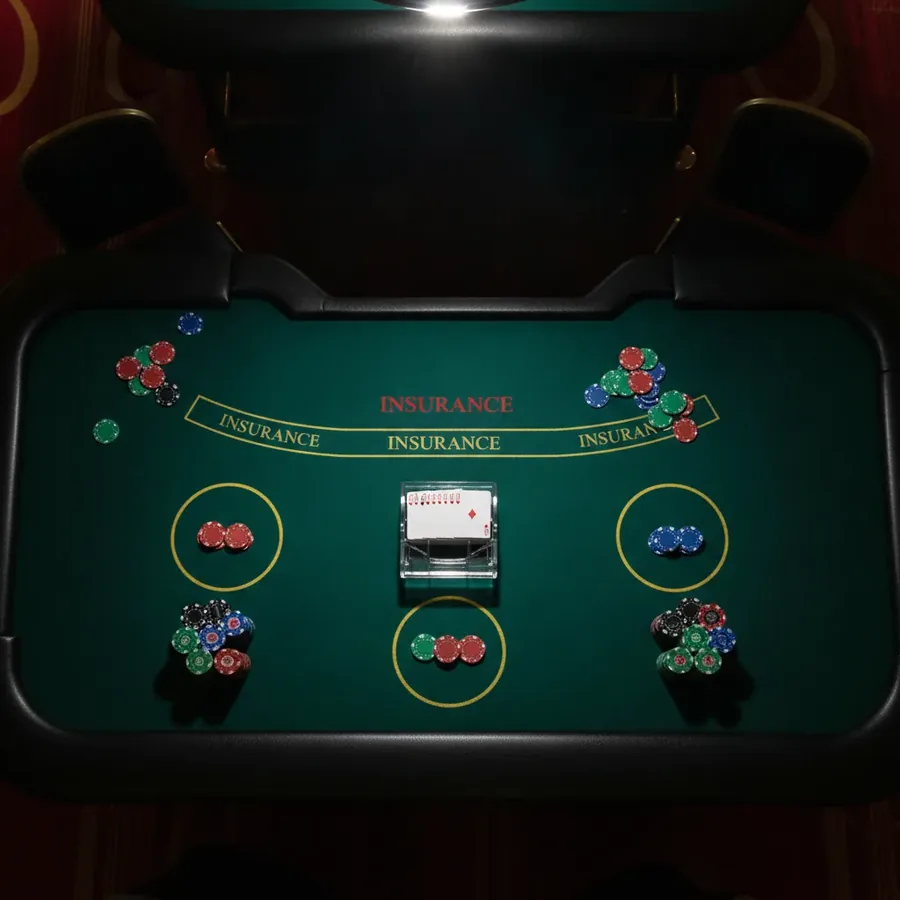
Insurance is a side bet paying 2:1 if the dealer possesses a ten-value hole card, but the RTP for this wager sits at a low 92.53% with a high house edge of 7.47%. Standard basic strategy dictates that players should always reject this offer unless they are counting cards and the true count reaches +3 or higher in multi-deck games.
For a standard €100 main bet, accepting Insurance costs an additional €50, which significantly drags down the overall expected return over thousands of hands. The separate nature of this bet means it does not improve the base game RTP, making it a costly proposition for recreational players who lack advanced counting skills.
Blackjack doesn't count for every bonus offer
The 300% welcome bonus up to €2,000 plus 100 free spins comes with specific contribution rules that heavily restrict how table games can be used to clear the wagering requirements. While slots contribute 100% toward the turnover calculation, blackjack tables only contribute 10%, drastically slowing down the process of meeting the playthrough conditions attached to the promotional funds.
A €2,000 bonus requires a total turnover of €80,000 if played entirely on slots, calculated as 2,000 times 40. However, playing blackjack with a 10% contribution rate means a €100 bet only counts as €10 toward the requirement, effectively multiplying the necessary volume by ten compared to slot gameplay.
This discrepancy forces players to choose between slow progression on tables and fast clearance on slots, impacting bankroll management strategies significantly. Players attempting to use blackjack to clear the bonus must wager substantially more money, exposing themselves to greater variance and potential losses due to the lower effective contribution rate of the game type.
Early Surrender is removed from many tables
Late Surrender allows players to forfeit half their bet after the dealer checks for blackjack, providing a modest improvement to the RTP by approximately 0.08 percentage points. This rule is available in some variants, whereas Early Surrender, which is far more valuable by reducing the house edge by up to 0.6 percent, is now extremely rare in online casino environments.
The availability of surrender options varies significantly across different software providers, with Quantum Blackjack Plus Live from Playtech offering specific multiplier features instead of traditional surrender mechanics. Evolution's Infinite Blackjack focuses on unlimited seats and side bets rather than early exit options, reflecting a industry shift away from player-favorable exit rules.
Without Early Surrender, players lose a critical tool for minimizing losses on weak hands against strong dealer upcards, increasing the long-term cost of play. The absence of this rule means that even with optimal basic strategy, the house maintains a slightly higher advantage compared to land-based casinos that still occasionally offer early exit privileges.
Which hands are excluded from Surrender?
Surrender is typically excluded from hands where the player has already split pairs or doubled down, as these actions finalize the bet structure before any exit option can be applied. In Blackjack 6 Decks with DAS (Double After Split) allowed, players cannot surrender after doubling, limiting the strategic flexibility during complex multi-hand scenarios.
Hands resulting from a split ace are almost universally ineligible for surrender because casinos usually allow only one additional card to be drawn per split ace. This restriction prevents players from using surrender as a way to mitigate losses on potentially weak two-card totals formed after splitting, thereby protecting the house edge in high-variance situations.
The exclusion criteria ensure that the mathematical advantage remains intact for the operator, as surrender is most beneficial when applied to initial two-card totals like 15 or 16 against a dealer 10. Once the betting phase evolves through splits or doubles, the opportunity to cut losses in half is permanently revoked under standard table rules.
Statistics display saves the last 100 rounds
The statistical history feature retains data from the previous 100 rounds, allowing players to track outcomes such as dealer busts, player wins, and specific card distributions over a short session. This functionality is particularly useful in live dealer games like Lightning Blackjack from Evolution, where visual cues and historical trends help inform immediate betting decisions.
In Quantum Blackjack Plus Live by Playtech, the statistics panel also correlates with quantum multipliers up to 1000x, showing how often high-value payouts have occurred recently. Tracking these patterns helps players manage their bankroll by identifying hot streaks or cold periods, although each hand remains an independent event statistically.
Evolution's Infinite Blackjack displays similar metrics for side bets like Any Pair and 21+3, giving insight into the frequency of these auxiliary wagers within the last hundred deals. This transparency aids in evaluating whether side bets are currently paying out above or below their theoretical RTP of roughly 95-96% depending on the specific variant.
Blackjack variants at a glance
| Variant | Payout | House edge | Rule | Bet range |
|---|---|---|---|---|
| Blackjack Surrender (Late Surrender) – Regel-Effekt | n.a. (Regel-Modifikator) | −0.08 Prozentpunkte | Spieler gibt Hand nach Dealer-Blackjack-Prüfung auf, verliert die Hälfte des Einsatzes. Verbessert RTP um ca. 0.08 Prozentpunkte. Early Surrender ist wesentlich wertvoller (bis −0.6 Prozentpunkte), aber extrem selten. | Rückzahlung 50% des Einsatzes |
| Blackjack Split / Double / H17 – Regel-Effekte | n.a. (Regel-Modifikatoren) | H17 +0.22 Prozentpunkte; RSA −0.08 Prozentpunkte; DAS −0.14 Prozentpunkte | Dealer Hits Soft 17 verschlechtert RTP um 0.22 Prozentpunkte; Resplit Aces verbessert um 0.08 Prozentpunkte; Double After Split verbessert um ca. 0.14 Prozentpunkte; 6 Decks statt 8 – ca. 0.02 Prozentpunkte. | Double – Einsatz ×2 mit einer Karte; Split – bis 4 Hände; Ass-Split meist mit einer Karte. |
| Blackjack 6 Decks, S17, DAS, DOA, Auszahlung 3:2, Basisstrategie | 99.54% | 0.46% | Dealer steht auf Soft 17; Verdopplung auf jeder Zweierkarte; Verdopplung nach Split erlaubt; keine Aufgabe. Basisstrategie ist für diesen Wert zwingend | Blackjack 3:2, normaler Gewinn 1:1, Insurance 2:1 |
| Blackjack Insurance / Versicherung (6–8 Decks) | 92.53% | 7.47% | Separate Nebenwette bis 50% der Hauptwette, wenn der Dealer ein Ass hat. Basisstrategie schreibt IMMER Ablehnung vor (außer Karten zählen bei True Count ≥ +3). Bei einem Deck Vorteil ≈ 5.88% | Insurance 2:1 |
| Blackjack Ein Deck, klassische Regeln, 3:2 | 99.85% | 0.15% | Weniger Decks = niedrigerer Vorteil; ein Deck gibt ca. −0.48 Prozentpunkte gegenüber 8 Decks. Oft durch 6:5 Auszahlung kompensiert. | Blackjack 3:2, Gewinn 1:1 |
| Blackjack Auszahlung 6:5 statt 3:2 (6 Decks) | 98.15% | 1.85% | Ersatz von 3:2 durch 6:5 fügt exakt +1.39 Prozentpunkte zum Vorteil des Casinos hinzu – stärker als jede andere Regeländerung. Bei $10 Einsatz zahlt Blackjack $12 statt $15. | Blackjack 6:5, Gewinn 1:1 |
16 vs 10 played incorrectly: most common error
The basic strategy for a hard sixteen against a dealer ten dictates surrender if available, as the house edge increases by 0.46 percent when standing. This specific rule configuration uses six decks with S17 and DAS, making the statistical loss from standing significantly higher than the potential gain. Players who refuse to surrender lose more money over time compared to those who take the late surrender option.
Surrendering allows the player to forfeit half the bet immediately, which improves the overall RTP by approximately 0.08 percentage points relative to playing out the hand. Without this option, the casino retains a larger share of the total wagered amount on these high-risk hands. The mathematical expectation shifts unfavorably when the player attempts to hit or stand on sixteen against a ten.
Infinite Blackjack vs Classic Seven-Seat Table
Infinite Blackjack by Evolution accommodates an unlimited number of players at the virtual table, whereas classic tables typically restrict access to seven physical seats. This variant allows bets ranging from 1 to 5,000 EUR, providing high limits for serious players without capacity constraints. The game maintains an RTP of 99.47 percent while offering four side bets including Any Pair and 21+3.
Classic seven-seat tables often feature stricter seating arrangements that limit concurrent participation during peak hours. Infinite versions remove this bottleneck, allowing multiple users to join the same shoe simultaneously without waiting for a seat. The structural difference impacts accessibility rather than the core mathematical advantage of the game itself.
Six Decks to Eight Decks in the Shoe
Using six decks instead of eight reduces the house edge by approximately 0.02 percentage points due to improved card removal effects. A standard six-deck game with S17 and DAS yields an RTP of 99.54 percent, slightly better than single-deck variants compromised by 6:5 payouts. Fewer decks generally favor the player by increasing the probability of drawing favorable cards in later rounds.
Single-deck games can offer an RTP of 99.85 percent but often counteract this advantage with inferior payout structures like 6:5 for blackjack. When comparing multi-deck shoes, the difference between six and eight decks is marginal but mathematically consistent. Players seeking optimal returns should prioritize rule sets over deck count alone, provided the payout remains 3:2.
Blackjack Contributes Only 10 Percent to Wagering
Table games contribute only 10 percent toward the wagering requirement for the 300% welcome bonus up to €2,000 plus 100 free spins. This low contribution rate means players must wager ten times more on blackjack slots to clear the same bonus amount compared to slot games. Slots contribute 100 percent, making them the efficient choice for meeting turnover conditions quickly.
Splitting tens costs expected value: better stand
Splitting tens against any dealer upcard results in a negative expected value because two separate hands starting with ten are statistically weaker than one strong twenty. Standing on a hard twenty guarantees a win against dealer busts and avoids the risk of breaking a premium hand. Basic strategy universally recommends standing on ten-plus-ten regardless of the dealer's visible card.
Set session stop after 30 percent loss
The house edge in standard six-deck Blackjack stands at 1.85 percent, a figure that directly impacts long-term bankroll erosion during extended play sessions on the platform. This statistical disadvantage compounds with every hand dealt, requiring disciplined management to prevent rapid depletion of the initial deposit balance over time. Setting a hard limit at 30 percent loss ensures players retain sufficient funds for recovery or exit before chasing losses becomes statistically futile and financially dangerous.
In contrast, liberal rule sets like Vegas Strip reduce the house advantage to just 0.28 percent, offering a significantly more favorable environment for strategic decision-making and sustained engagement. The Quantum Blackjack Plus Live variant by Playtech maintains a competitive RTP of 99.57 percent, though its high volatility demands careful stake sizing relative to the total available balance. Players must weigh these structural differences against their personal risk tolerance when determining appropriate session durations and maximum acceptable loss thresholds for any given playing period.
Live stream with three cameras and OCR
Evolution provides Infinite Blackjack with unlimited seating and four distinct side bets, including Any Pair and Bust It, while maintaining an RTP of 99.47 percent through precise card recognition technology. The streaming infrastructure utilizes multiple camera angles to ensure transparency, allowing players to verify dealer actions and card distributions in real-time without relying solely on software-generated outcomes. This visual verification process enhances trust in the game integrity, particularly when placing higher stakes up to 5,000 EUR per round during peak activity periods.
Mobile version needs 1 Mbit bandwidth
Lightning Blackjack by Evolution requires stable connectivity to handle its unique lightning multiplier feature, which awards payouts up to 25 times the original wager on winning hands involving specific card combinations. The mobile interface supports wagers ranging from 1 to 2,500 EUR, demanding a minimum bandwidth of 1 Mbit/s to prevent latency issues that could disrupt the timing of critical betting decisions. Insufficient connection speeds may result in missed opportunities to capitalize on these enhanced payout multipliers, effectively reducing the potential return on investment for active participants.
Register Late Surrender correctly in three steps
Late Surrender improves the player's expected return by approximately 0.08 percentage points by allowing them to forfeit half their bet after the dealer checks for blackjack, provided no natural ace or ten is present. This rule modifier applies only when the dealer does not hold a blackjack, making it a crucial tool for minimizing losses on weak starting hands against strong dealer upcards during gameplay. Implementing this strategy correctly requires understanding the specific timing constraints and ensuring the option remains available within the current table configuration offered by the casino platform.
Splitting Eights vs Standing on 16
Basic strategy mandates splitting eightes regardless of the dealer's upcard, as two separate hands starting with four offer better mathematical prospects than standing on a rigid sixteen against most dealer positions. The hit soft seventeen rule adds 0.22 percentage points to the house edge, slightly altering the optimal approach compared to dealers who stand on all soft seventeen totals during play. Resplitting aces improves returns by 0.08 percentage points, while doubling after split enhances them by 0.14 percentage points, collectively refining the strategic framework for maximizing long-term profitability.
Contact
Live - online chat
Banking






Providers










Gamdom Casino 2026